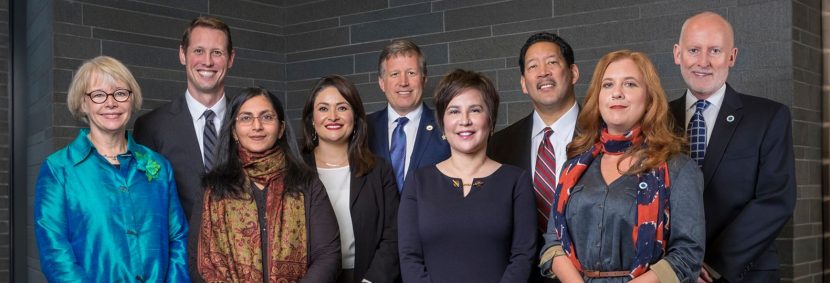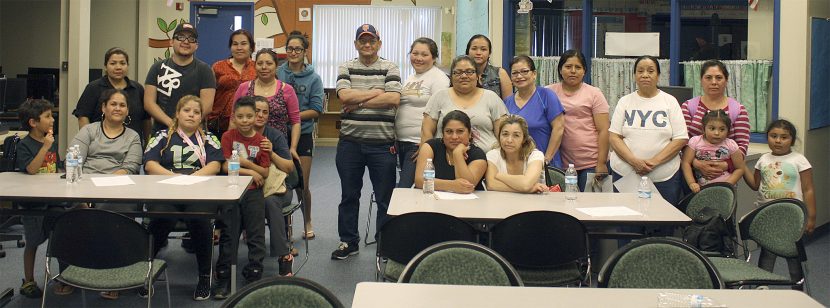
An expert panel of community members who have experienced homelessness spoke at the Conference on Ending Homelessness. Photo credit: Janice Tufte.
The Washington Low Income Housing Alliance's excellent 2013 Conference on Ending Homelessness featured many of the speakers you'd expect -- direct service providers, policy wonks, elected officials, and leading advocates. But organizers also offered a panel discussion by experts we don't see often enough at these types of gatherings: people who have experienced homelessness themselves. They are, of course, voices we should be listening to as we advocate for an end to homelessness, and we commend the Housing Alliance for including their perspectives. We recorded a couple of their stories, and we've included videos of Mindy and David.
Featured advocate Norene Roberts has worked as a social services provider for over a decade.
What's the first step you should take when you advocate for an end to homelessness? Listen. "Advocating for any person or group first requires that you know what it is that that person or group wants and needs – not what we think they want and need – and that requires opening your ears before your mouth," says Norene Roberts, program manager at The Salvation Army’s Catherine Booth House, a domestic violence shelter for women and children. Norene shares her thoughts on advocating for housing stability in this installment of our "I'm An Advocate" series.
Monica and her eight-year-old son Eric are grateful that the Housing Trust Fund helped build their safe, affordable community. Two years ago, they were on the verge of homelessness. Photo credit: Degale Cooper.
Right now our state lawmakers are making important decisions about investment in the Housing Trust Fund. Their budget decisions will have life-altering effects on people statewide. Through our "Policy Matters" blog series, we’re introducing you to community members who are directly impacted by state housing policies. Monica, a single mother who was on the edge of homelessness but found stability at a community built by the Housing Fund, shares her story in today’s post. Read Monica’s story and find out how you can advocate for a budget that invests in families and communities.
Single father Ron Sordahl and his son Tommy live atYWCA Family Village at Issaquah, an affordable community built with help from the Housing Trust Fund.
On Monday state lawmakers started a special session to work toward a budget agreement. Their decisions about investment in social safety-net services for the disabled and the Housing Trust Fundwill affect community members across the state. Our "Policy Matters" blog series introduces you to people whose lives are directly impacted by state housing policies. Today we share the story of Ron, a single father who lives at YWCA Family Village at Issaquah. Ron's community, along with many other safe, affordable homes, was built with help from the Housing Trust Fund. Read on to find out how this fund helps people like Ron, and what you can do to encourage our legislators to invest in our communities.
This month in Olympia, Washington's lawmakers will come together to hammer out a budget agreement. With investment in social safety-net services and the Housing Trust Fund on the line, our legislators' decisions will have a huge impact on YWCA clients and other community members across the state. In a guest opinion piece published today on Crosscut.com, YWCA Seattle | King | Snohomish CEO Sue Sherbrooke asks state budget negotiators "to step back from the revenue and expense line items for a moment and look at these big-picture budget matters with an eye for the bigger picture."
Two Walla Walla citizens demonstrate for the passage of a fully inclusive Violence Against Women Act during a rally held in February 2013. Photo Credit: Madelyn Peterson.
This year's reauthorization of the Violence Against Women Act (VAWA) will continue to bring the United States closer to decreasing the incidence of and improving the services for domestic violence and sexual assault. The expansion and renewal of VAWA was essential—and it’s great that we can move forward with it. But there are many needs that the law has yet to meet. This post by YWCA Walla Walla Communications Coordinator Sara Rasmussen considers the improvements made in the current version of VAWA, as well as its limitations. Sara also introduces you to our Stand Against Racism blog series, which will examine how discrimination and institutional racism create barriers for violence survivors trying to access housing services and resources.
YWCA Opportunity Place resident Shelby Powell was on track to attend medical school when she was diagnosed with schizophrenia. She couldn't hold down a job, and became temporarily homeless. Shelby has faced many challenges since her diagnosis, but she's thankful for the financial support she receives through the Aged, Blind & Disabled (ABD) program, which has helped her afford her rent and basics like bus fare and cleaning supplies. She testified at the state capitol, asking legislators to protect the social safety net that has kept her stably housed. Watch Shelby's testimony and learn how you can advocate for lifeline programs like ABD.
We didn’t look very far when we decided who to interview for this third installment of our "I'm An Advocate" series! Denise Miller is the new Firesteel Advocacy Coordinator and the co-founder of ChangeStream Media, a nonprofit organization that uses digital storytelling to advocate for social justice. She shared her motivation for speaking up for housing issues, along with her thoughts on how digital storytelling can spark change.
YWCA Family Village at Issaquah resident Linda says the community, built with Housing Trust Fund dollars, offers "more than just a place to live." Photo credit: William Wright.
In the "Policy Matters" blog series, we're sharing stories from people who are directly affected by state housing policies. Today's post introduces you to Linda, a grandmother with limited resources who lives at YWCA Family Village at Issaquah. Linda's community, along with many other safe, affordable homes, was built with Housing Trust Fund dollars. Unfortunately, this vital fund is under threat. Housing advocates call for a $175 million investment, but the recently released Senate budget allocates only $35 million for the Housing Trust Fund. Read on to find out how you can ensure we invest in our communities.
Nikkisha was denied housing after she got a protection order against her abusive ex-boyfriend. Image credit: Vine Maple Place.
When Nikkisha bravely stood up to her abusive boyfriend and got a protection order against him, she faced a repercussion she never expected: She was denied housing because of her history as a domestic violence survivor. With two children and a third on the way, Nikkisha became homeless, bouncing from shelter to shelter and washing up at a restaurant.
When tenant screening reports include domestic violence records, stories like Nikkisha's are all too common. This family's experience is a powerful example of the need to break down housing barriers and keep domestic violence records off of tenant reports. Fortunately, state lawmakers are close to enacting legislation that will help protect domestic violence survivors like Nikkisha from discrimination when they apply for housing. The Fair Tenant Screening Act has received bipartisan support, and is on its way to becoming law.
Read more about Nikkisha, and learn how you can help ensure other domestic violence survivors don't face the same housing barriers that she did.
Over the next few weeks, legislators are making important decisions about the state budget, including the Housing Trust Fund. Their decision to invest in the Fund can help end homelessness. How? Our new infographic breaks it down and shares advocacy steps you can take today.
In this second installment of our "I'm An Advocate" series, we introduce you to a longtime legal advocate. Kay Field created the free family law clinic at YWCA Pathways for Women in 2002, and has operated it ever since. She helps low-income women in Snohomish County navigate the legal system and fight for their rights. Kay shares her story about how she came to be an advocate, and how she does her important work.
YWCA Family Village at Issaquah residents Sharon and her granddaughter Charon love their new home, which was built with the help of Housing Trust Fund dollars. Before they found this permanent, stable housing community, they were crowded in a studio apartment in a neighborhood that felt unsafe.
With about four weeks left in this legislative session, the Firesteel team continues to advocate for the Fair Tenant Screening Act, as well as investment in the Housing Trust Fund and Housing and Essential Needs program. We’ve laid out the reasons we believe in these policies, and many of you have added your voices using video comments. Now, with our new “Policy Matters” blog series, we want to share some personal stories from community members who are affected by these policies. The first story is about a family whose lives were changed when they moved into YWCA Family Village at Issaquah, a community built with Housing Trust Fund dollars.
We're excited to launch our newest series, "I'm An Advocate!" Have you ever wondered what it means to be an advocate? Where do you begin? At Firesteel, we think that advocacy in its simplest form is speaking up and people do that in lots of different ways. There is no one "type" of advocate; we're a diverse community! In this series, we'll introduce you to many different housing advocates and hope you'll find inspiration to speak up in your own way. Our very first highlighted advocate is Kim Herman, the Executive Director of the Washington State Housing Finance Commission.
(L-R) Project coordinator Graham Pruss and project assistants/Seattle U students Ashwin Warrior, Judy Pansullo and Perry Firth from the Project on Family Homelessness stand on the steps of the Capitol Building. Photo credit: Catherine Hinrichsen
Perry Firth is a graduate student and a project assistant for the Seattle University Project on Family Homelessness. She attended the Housing & Homelessness Advocacy Day in Olympia for the first time this year. Two more Seattle U grad students and project assistants attended for the first time too. In this post, Perry shares their reflections as first time participants. In Perry's words, "I would say that sometimes you may feel that advocacy doesn’t work. It can be hard to connect your own actions and awareness-raising to meaningful policy change. But it is only through advocacy and collaboration that systemic change ever occurs." Learn more about the advocacy that happened on February 11th!
Housing advocates convene on the steps of the state capitol to rally for affordable homes for all.
On January 11th, over 650 housing advocates came together in Olympia, our Washington state capitol, and spoke up for affordable housing. Hosted by the Washington Low Income Housing Alliance, it was the largest Advocacy Day yet. We represented 43 out of our 49 state voting districts! Why did so many people make the trek to Olympia? Hear from participants directly in the following post and learn how Firesteel and the YWCA contributed.
The 2013 Washington State legislative session begins today. Which means we are mobilizing to advocate! The quote above reminds us that we can all be advocates. It's time to introduce you to our 2013 Firesteel policy priorities and then we'll take you through some new ways we plan to speak up.
"July 2012 has been designated as National HIV Awareness Month. The goal of National HIV Awareness Month is to re-ignite our national discourse on the domestic HIV/AIDS epidemic in order to create broad-scale public awareness of HIV/AIDS, end HIV stigma and discrimination and engage new stakeholders in the fight against the disease, with the ultimate goal of ending the epidemic." Learn more HERE.
Every time I hear of people’s prison experiences, I shudder. I cannot imagine “living” in a small, cold room with other people, constantly being watched over but being surrounded by solitude, loneliness and my own private thoughts........
We continue our series, "Not a Prisoner of the Past," exploring the challenges facing women and families that are attempting to build their life again after being incarcerated and other life changing circumstances. This is our fifth post in this series and Andrea VanHorn continues to invite us into the YWCA Seattle I King I Snohomish Passage Point, a supportive residential community for parents discharged from the corrections system who would otherwise be homeless and who seek to reunite with their minor children and families. We introduced you to Nora in this earlier Photo Friday post, and now share her story along with others below.
When YWCA staff approached me asking if Firesteel could help raise awareness of their participation in the 38th Annual Pride Parade in Seattle, I said, "Sure! How can we connect this to housing and homelessness?" One Family Advocate, Nora, stepped forward and offered to write not one, but 5 blog posts related to housing challenges facing the LGBTQ community and the importance of YWCA participation in the Pride Parade. Thank you Nora! Because of her thoughtful writing and time, we have the following blog posts, compiled here for easy reference.
In the week leading up to the Pride Parade in Seattle, we continue our series, "Participating & Proud." YWCA Seattle I King I Snohomish staff and volunteers are participating in the parade this upcoming Sunday and we will take you through many of the reaons why it is important to do so. Nora Johnson, a Family Advocate at the YWCA I Seattle I King I Snohomish Family Village in Mountlake Terrace, takes us through the meaning of the "T" in the acronym "LGBTQ" and how programs can provide needed services for this community.
In the week leading up to the Pride Parade in Seattle, we continue our series, "Participating & Proud." YWCA Seattle I King I Snohomish staff and volunteers are participating in the parade this upcoming Sunday and we will take you through many of the reaons why it is important to do so. Nora Johnson, a Family Advocate at the YWCA I Seattle I King I Snohomish Family Village in Mountlake Terrace, highlights some of the federal housing policy changes to address the needs of LGBTQ communities.
It’s Gay Pride Week in Seattle, and YWCA I Seattle I King I Snohomish staff and volunteers are proud to be participating in the parade this upcoming Sunday. It is also a perfect time to introduce the Firesteel community to the work of Sexual Orientation/ Gender Identity (SO/GI) Committee here at our YWCA. Nora Johnson, a Family Advocate at the Family Village in Mountlake Terrace, is a member of the SO/GI committee and will take us through our next series named, "Participating & Proud." Why is there a need for a Sexual Orientation/ Gender Identity Committee at the YWCA? Why are staff and volunteers participating in the Pride Parade? How does any of this connect to housing and homelessnes? We're covering all that and more!
It's another Photo Friday in the "Not a Prisoner of the Past," series, exploring challenges facing women and families that are attempting to build their life again after being incarcerated and other life changing circumstances. We introduced you to Tiffany in our earlier post, "Struggle and Survival: Learning about Domestic Violence." Tiffany and her son are residents of the YWCA Seattle I King I Snohomish Passage Point, a supportive residential community for parents discharged from the corrections system who would otherwise be homeless and who seek to reunite with their minor children and families. Passage Point also offers support for women, like Tiffany, who are survivors of domestic violence.
Tiffany shares a special moment with her son who has reunited with her at Passage Point.
We continue our series, "Not a Prisoner of the Past," exploring the challenges facing women and families that are attempting to build their life again after being incarcerated and other life changing circumstances. This is our third post in this series, examining domestic violence. Andrea VanHorn shares more about her work at the YWCA Seattle I King I Snohomish Passage Point, a supportive residential community for parents discharged from the corrections system who would otherwise be homeless and who seek to reunite with their minor children and families. Passage Point also offers support for women, like Tiffany, who are survivors of domestic violence.
We continue our series, "Not a Prisoner of the Past," with a Photo Friday post highlighting the gardening work party that took place at theYWCA Seattle I King I Snohomish Passage Point last weekend. This series explores the challenges that women face who attempt to rebuild their lives after incarceration and other life-changing circumstances. Passage Point is a supportive residential community for parents discharged from the corrections system who would otherwise be homeless and who seek to reunite with their minor children and families.YWCA Gen-Risers came out to support the program by pulling on gloves and getting dirty!
We now start a series exploring the challenges facing women and families that are attempting to build their life again after being incarcerated. Stable housing is the most critical element for successful re-entry. Many of us would first think of employment as the foundation for rebuilding a life, but actually, stable housing and a safe home is an even bigger factor.
This is the first post in this series named "Not a Prisoner of the Past," and Andrea VanHorn shares about her work at the YWCA Seattle I King I Snohomish Passage Point, a supportive residential community for parents discharged from the corrections system who would otherwise be homeless and who seek to reunite with their minor children and families.
YWCA Opportunity Place--Site of the Worksource Program.
Memorial Day may have passed but outreach to our veterans continues. Over the weekend, the YWCA USA blog highlighted the YWCA Seattle I King I Snohomish services for veterans. Matt King, a Senior Program Director at the YWCA Seattle I King Snohomish wrote this piece that was posted on the National blog and we are excited to share it here as well.
Today we get to hear from another YWCA Seattle I King I Snohomish staff member, Joanna den Haan! Joanna is a Housing Case Manager at the YWCA and works with many undocumented immigrants. In light of the May Day Immigrant Rights March in Seattle last week, Joanna shares some of the challenges that these immigrants face. Find out what Joanna thinks some solutions to these challeges are..
Rick Derksen and his wife recently moved to Seattle. His house hunt brought him to a home just off of Martin Luther King, Jr. Way where the Central District, Madrona, and Leschi meet, not far from downtown Seattle. They wanted to live in an area with racial and cultural diversity. Rick shares his discovery of how he unwittingly participated in gentrification, an example of systemic racism that, in some ways, has replaced the restrictive covenants of the past. How does he deal with this knowledge and the accompanying feelings? Read on.
I recently was searching for a new rental and spending lots of time on Craigslist. Every time I move, I always consider what neighborhood I would prefer to live in and the characteristics that come with the neighborhood. Diversity is important to me but it seems odd that diversity is a characteristic that can be applied really to only a few neighborhoods, and those neighborhoods have changed over time. Why is this? I've come across a few resources that give great insight into the history of Seattle housing. We live with a legacy of structural racism that has shaped our neighborhoods. That racism may not be as overt today, but there is even more power in its current subtleties as it continues to influence our housing choices.
Our Stand Against Racism series kicks off with the YWCA Seattle I King I Snohomish Employment and Regional Services Director, Matt King, exploring the impact of racism in the criminal justice system. Discrimination may no longer be legal against groups defined by race, gender or other protected characteristics. But there is at least one group against whom discrimination in employment and housing remains legal – those with criminal records. What does this have to do with race? Read on!
We are continuing our affordable housing series and now take a look at Whatcom County. Greg Winter of the Whatcom County Coalition for the Homeless took time to share a snapshot of affordable housing in Bellingham and its surrounding area.
Clark County Independent Living Skills Program, supporting foster youth and alumni as they age out of care
This is the first in our series examining affordable housing in YWCA communities across our state. Each of our partnering Firesteel YWCAs will be sharing what they are seeing in their community. We'll be hearing from YWCA Program Directors, coalition leaders and more. The YWCA Clark County is kicking it off for us!
The Snohomish County Point in Time Homeless Count helps to ensure that vital federal and state funding continues to come into the community to fight and end homelessness. On January 26, 2012, many Point in Time volunteers are experiencing homelessness themselves. Hear one man's motivation for volunteering in addition to some reflections on how homeless counts differ across counties.